During the late 1960s, Bewitched became known for blending everyday life with subtle magical elements. Its charm came from how effortlessly the unusual was woven into normal situations.
But every now and then, a scene stood out—not because of obvious magic, but because something felt slightly off.
This is one of those moments
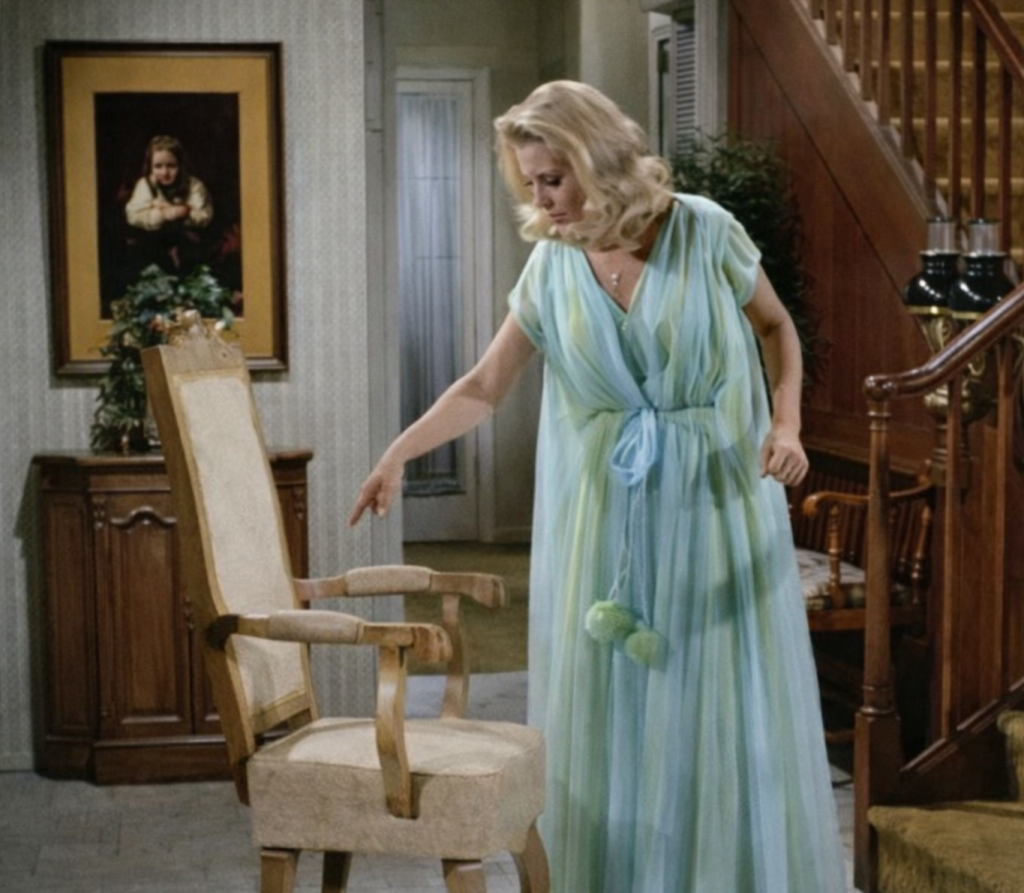
At first glance, the scene appears simple. A character stands in a familiar setting, interacting with an ordinary household object—a chair. The environment is calm, the lighting is consistent, and nothing immediately signals anything unusual.
But then your attention shifts.
Not to the character…
but to the chair itself.
Something about its position and behavior doesn’t seem to match the moment. It’s subtle, but noticeable enough that some viewers began to question whether what they were seeing was intentional—or something that slipped through unnoticed.
In a show like Bewitched, where magical effects were part of the storytelling, moments like this could easily blur the line between planned illusion and accidental detail.
Was it meant to be a magical hint?
Or was it simply a production quirk?
Television production during that era relied heavily on practical effects. Objects were often moved using wires, clever camera cuts, or manual positioning between takes. Sometimes, these techniques created brief inconsistencies that sharp-eyed viewers could catch.
Over time, scenes like this have gained attention not because they were dramatic—but because they were just unusual enough to stand out.
And once people started noticing…
they couldn’t stop looking.
That’s what makes this moment so interesting.
It’s not obvious.
It’s not explained.
But it leaves just enough doubt to make you watch it again.
Take another look.
You might see what others did.
